not all men
just make sabr right?

not all men but enough men that every women has a story … of being abused, of being a survivor, of feeling unsafe in the street, in the shop, at work, in public, at home and so on.
today is the national shutdown organised by women for change. it’s a call for gender-based violence to be classified a national disaster by the government of south africa. all of the stats are available about the massive issue of femicide and gender-based violence in south africa.
but i want to speak about something else today. i want to address the muslim and in particular the indian muslim community in south africa. when the profile pictures started changing to purple and people started posting about the shutdown, there was a post going around with the hadith of Prophet Muhammed (PBUH).
Abu Hurairah (May Allah be pleased with him) reported: Messenger of Allah (ﷺ) said, “The believers who show the most perfect Faith are those who have the best behaviour, and the best of you are those who are the best to their wives”. [At-Tirmidhi, who categorized it as Hadith Hasan Sahih].
Riyad as-Salihin 278
there were also other posts going around speaking about the role of women in Islam. we know that the Prophet is the best person and best example of a man. the Prophet never raised a hand to women and elevated the role of women in a time when women were considered nothing.
we all know that.
but it makes me uncomfortable when people only share those posts and don’t speak about the reality of women, Muslim women in south africa at this point in time.
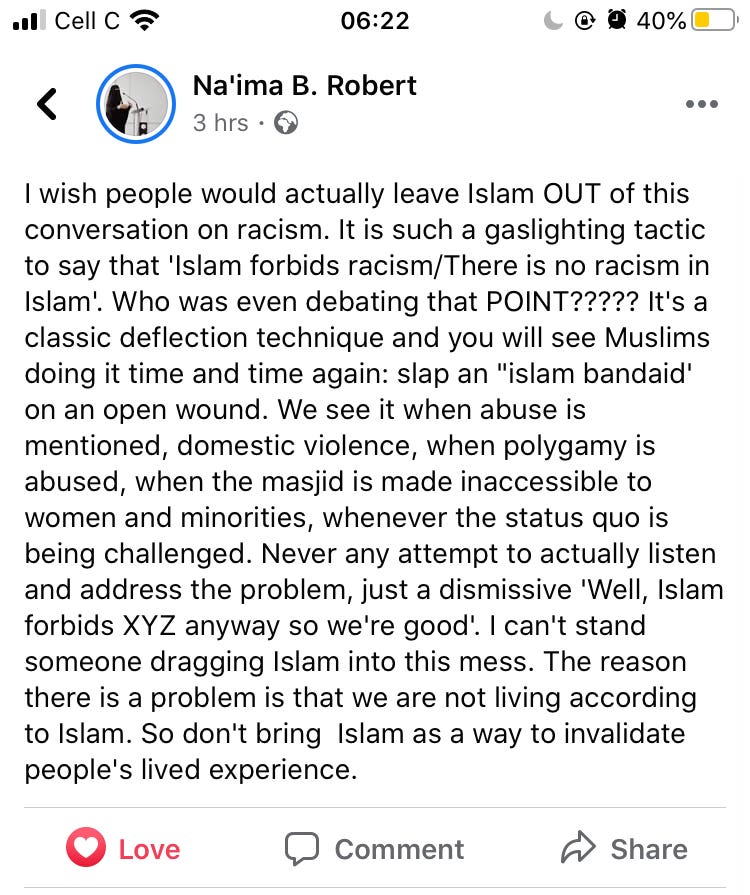
there was a post from author Na’ima B. Robert a few years ago during the #BlackLivesMatter protests when she wrote that she wished that people would actually leave Islam out of the conversation on racism. She calls it a gaslighting tactic (Full post below)
And this post sums up my feelings around the discomfort I was feeling with regards to those posts. I’ll paraphrase and say i wish people would leave Islam out of the conversation of gender-based violence and femicide.
we know what the Quraan and Sunnah say about how women should be treated.
but we also know that what we’re meant to do according to the Shariah and what Muslims actually do is a huge gap.
we need to speak about the actual lived realities of muslim women.
muslim women in south africa, in our communities, in our families who are victims, survivors of abuse.
who are silenced by our communities and are unable to speak about what is happening to them.
who are told that they need to make sabr.
whose experiences are hidden under the carpets of “what will people say” or “he’ll change” or “he’s just angry - you know how men get” or “why did you go out - good Muslims girls don’t leave the house” or or or or or
the list goes on.
muslim men are perpetrators. the men who walk to mosque to pray there five times a day. the supposedly perfect father, the son. the person you’d never expect.
we cannot ignore this and act like gender-based violence is a problem that occurs out there. to other people. to other communities.
it’s happening within our communities with the perpetrators living amongst us.
covering for the sins of your fellow muslim does not apply when the sin and injustice and dhulm is being carried out against another person.
until the oppressed person’s rights are fulfilled, the oppressor must be held responsible and accountable.
we need to educate muslim men and women about their rights and responsibilities. about following the noble traditions of our religion and our pious predecessors
but if we only focus on that and we don’t create a space for survivors to speak up, to talk and to share their experiences
a space where we listen and create accountability
then we are silencing survivors in the name of religion and that goes against everything Islam has taught us about justice and social justice.
The Prophet ﷺ quoted Allah as saying, “O My servants, I have forbidden oppression for Myself and have made it forbidden amongst you, so do not oppress one another.” (Sahih Muslim, no. 2577) This hadith qudsi (a hadith whose meanings are from Allah) reveals that injustice is prohibited by Allah Himself and must be entirely avoided in all dealings with others.
our duty as muslims is about preventing oppression and bringing justice
and that includes survivors of gender-based violence
we need to stop victim-blaming
we need to stop hiding things because of misplaced shame and honour
we need to amplify the voices of survivors.
create spaces for their voices and stories
and most importantly we need to create accountability.
the criminal justice system has failed many survivors but we cannot hide behind solving things within communities.
survivors of gender-based violence and sexual violence whether they are women, girls, men or boys deserve justice and accountability.
let’s not invalidate survivors’ experiences and let’s practise justice as our religious duty.